


Towards a Postmodern Landscape
If you surrendered to the air, you could ride it. — Toni Morrison
American fiction of the 1960s, '70s and beyond saw the emergence o
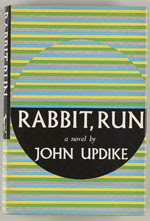 f postmodern literature, and the novels of this period can be sprawling, picaresque narratives. But they are also distinguished by insightful investigations of character and identity, and a kind of "tender, discerning study of the desperate and hungering in our midst," as one reviewer characterized John Updike’s Rabbit, Run. Many of the works in this section are deeply autobiographical, and all are, of course, influenced by the cultural landscape in which they were written. Carter Burden, who built his library on a foundation of James, Hemingway, and Faulkner — all acknowledged masters of the craft — made his collection uniquely broad by continuing to acquire recent and contemporary fiction. Collecting the works of living writers, Burden was able to purchase original manuscripts and letters, and important pre-publication copies, such as the copy of Toni Morrison's Song of Solomon that was used — and annotated — by Reynolds Price when preparing his New York Times review. He sometimes acquired works directly from the authors themselves, as we find in his correspondence with John Updike and an inscribed copy of Jeffrey Eugenides' debut The Virgin Suicides — one of the last books that Burden added to his collection.
Developments in Poetry
New Art should not arouse hostility among the learned, but does, and always has.—Allen Ginsberg
Experimental mid-century American poetry had strong links to — but
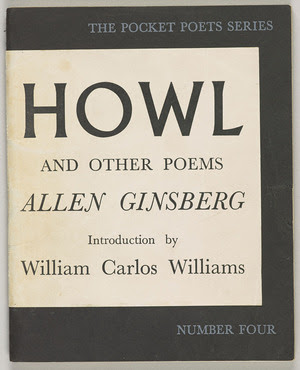 significantly broke away from — the inventions (and subsequent traditions) of the earlier Modernists. Ezra Pound and William Carlos Williams served as important literary examples and mentors to the younger generation, as evidenced in a copy of Robert Creeley's The Immoral Proposition, which he inscribed "with all love" to Williams. Williams also wrote the introduction to Allen Ginsberg’s Howl. Some mainstream critics derided the explicit rawness and emphasis on natural expression over traditional poetic structures, and the first book to anthologize the experimental poets emerging in the postwar years was The New American Poetry, 1945-1960, edited by Donald Allen. This collection of counter-culture verse — which still stands as an important reference work—was Allen’s attempt to bring to light the third generation of modernist poets who had been "long-awaited, but only slowly recognized," and it was here that the Beats, San Francisco Renaissance, New York School, and Black Mountain poets were designated the new avant-garde. Frequently publishing their work in small private press editions or now-ephemeral formats (Kerouac's is the only work in this section issued by a mainstream publisher), these texts are scarce in their original formats, even while they are today widely reprinted and continue to be influential.
Organization and Sponsorship
Gatsby to Garp: Modern Masterpieces from the Carter Burden Collection is organized by Carolyn Vega, Assistant Curator in the Morgan’s Department of Literary and Historical Manuscripts.
www.themorgan.org
Just a short walk from Grand Central and Penn Stations
More Articles
- Ferida Wolff's Backyard: Mushrooms, Mushrooms, Mushrooms and An Observational Trek
- Julia Sneden Wrote: Love Your Library
- The Morgan's Charles Dickens's A Christmas Carol: Christmas is nothing more than “a time for finding yourself a year older and not an hour richer”said Scrooge
- Serena Nanda Reviews Light in Dark Times: The Human Search for Meaning
- Ferida Wolff's Backyard: Blond-Tailed Squirrels and a Box Turtle Surprise Again
- What Should I Read? The New York Public Library Selects Best Books of 2019 for Kids, Teens and Adults
- Sanditon by Jane Austen And Another Lady: "Women drive this ... They're so well written ..."
- Worth Revisiting: Joan Cannon's Review of Islandia, a Novel of Remarkable Length Nowadays
- And Now for Something Different, Respected and Available to Project Gutenberg: Louisa May Alcott, Little Women and Other Writings
- Updated: Continuation of House Select Committee on Intelligence Hearings: Williams, Vindman, Volker, Morrison, Sondland, Ms. Cooper & Mr. Hale; Dr. Hill


