


Jacquy was concerned about leaving his family behind for six weeks while he practiced in France. He left Chicago and the pastry school determined but with a heavy heart. The filmmakers catch up with Jacquy in a storybook Alsatian village where he and his assistant Kurt are working in a make-shift kitchen over the bakery of Pierre Zimmerman, a childhood friend, himself a world champion in bread baking. For weeks, Jacquy creates and tests recipes using local ingredients. But pressures mount and when forced to redefine his vision for both his sugar sculpture and the wedding cake, he finds himself falling behind schedule. With the deadline approaching Sebastien hurries to France to supervise a three-day time trial for Jacquy and see if some of the complexity of the planned recipes could be reduced to save time. The trial shows them that Jacquy has a lot of changes to make before the competition that awaits him in Lyon only a week away.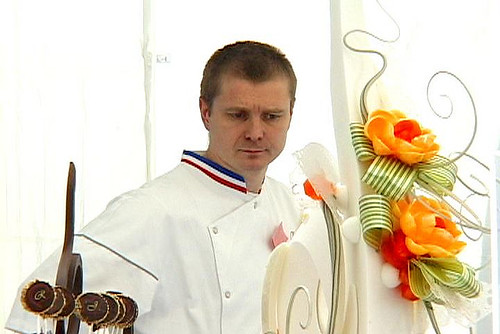
In France the film also follows French chefs Regis Lazard and Philippe Rigollot, two other finalists preparing for the competition. Regis works at a patisserie in nearby Luxembourg and is being coached by the pastry chef for French President Nicolas Sarkozy. This is the second time Regis has competed for the M.O.F. The first time he lost his balance climbing the stairs leading to the buffet area and dropped his sugar sculpture. The memory of this disaster still haunts Regis as he prepares to try once more for the prized collar. For all the finalists, the strain of the contest, both financially and personally, is enormous. Regis' wife explains, "When we built this house, before building the bedrooms and kitchen, we built this special kitchen in the basement for him to practice for the M.O.F. It was his dream so I let him do it again, but if he doesn’t get it this time, that's it."
Philippe Rigollot is the pastry chef at the renowned Maison Pic, the only three-star restaurant in France owned by a woman. Growing up in the bakery where his mother worked, it has been Philippe's lifelong dream to wear the tri-color collar of the M.O.F. chefs. His wife, a chocolatier, also works at Maison Pic. She helps her husband prepare for the competition along with two other coaches, each highly regarded M.O.F’s.
Jacquy, Regis and Philippe are three of sixteen finalists chosen from seventy French pastry chefs who competed in the grueling two-day semi-final process earlier that year. For the final competition they traveled to Lyon, long considered the country's culinary capital, where Paul Bocuse, father of contemporary French cuisine, has his elegant restaurant. During the next three days of mixing, piping, and sculpting, the finalists create an astounding array of products for their required buffets, including a tiered wedding cake, delicate cream puffs and chocolates, tea pastries and jams, a restaurant-style plated dessert, a chocolate sculpture and a sugar sculpture. In addition to this, each chef brings a 'bijou' — a small sugar sculpture specially designed for this event and presented in a glass box like a museum piece. As if all this were not enough, after the first day of the competition, they are given a surprise, a special desert to be created in addition to all their other items. The finalists, pastry marathoners racing the clock, must work spotlessly and with amazing sang-froid as they produce confections of exquisite taste and beauty working under constant scrutiny by master judges who weigh their products (rigid weight requirements apply), inspect their equipment and aprons (fingerprints are not permitted), and even examine their trash (no discarding of surplus). Their final pastries are then judged by the critical palates of some of the most famous chefs in their field and each final spectacular buffet is evaluated for artistic presentation.
The Meilleurs Ouvriers de France, created nearly a century ago to help preserve the quality of French artisan trades and to affirm the importance of manual work in a society that has historically prized intellectuals, is known throughout France as the official mark of the country’s most accomplished artisans. The pastry competition — each artisan trade has its own — is regarded as one of the most rigorous of the M.O.F. contests and the few laureates chosen at the end will join the ranks of their celebrated M.O.F brethren, proudly wearing the blue, white and red collar.
In awarding its laureates presidential recognition as well as academic diplomas, the M.O.F recognizes those whose artistry, and technique ensure that the French artisan trades, pastry arguably France’s defining artisan trade, adapt continuously and remain a vibrant force in French life.
At the Elysee Palace five of the sixteen competing pastry chefs received the Meilleurs Ouvriers de France award from President Nicolas Sarkozy. For Jacquy, Regis and Philippe, the passion, sacrifice, disappointment, and joy epitomize the high stakes quest to become one of the Co-founders of The French Pastry School in Chicago. 
Kings of Pastry at Amazon
1. Chef Jacquy Pfeiffer. Credit: Nick Doob
2. Chef Sebastien Canonne surveys Chef Jacquy Pfeiffer's final buffet at the MOF competition in Lyons, France, 2007. Credit: D A Pennebaker
More Articles
- Encore: Kitchen Stigmata and There Are Many Ways to Identify a Good Cook by Julia Sneden
- FDA Finalizes Historic Rule Enabling Access to Over-the-Counter Hearing Aids for Millions of Americans More Affordable Hearing Aids Could Be in Stores as Soon as Mid-October
- Jo Freeman's Review of "Frankly, We Did Win This Election" By Michael C. Bender
- Dereliction of Duty: Examining the Inspector General’s Report on the FBI’s Handling of the Larry Nassar Investigation
- Federal Reserve Bank of St. Louis: US Economic Activity Contracted Sharply During 2020 As Covid-19 Spread and Government Introduced Policies Aimed At Curbing the Virus
- In the We Couldn't Resist Category: Just Icing on the Cake, Part One, by Roberta McReynolds
- GAO: COVID-19 Complicates Already Challenged FDA Foreign Inspection Program; It Could Be 2 to 3 Years Before New Staff Are Experienced Enough To Conduct Foreign Inspection
- Automatic Stabilizers: What Are They and Do They Help Workers Who Stay Home Due to the Corona Virus?
- Rose Mula Writes: If You Can't Stand the Heat ... How About a Subscription to One of the Popular Meal Preparation Kit Services; What an Inspired Idea!
- My Mother’s Cookbook Frosted Cakes: Seven-Minute Frosting, 1234 Cake, Pound Cake Torte and Carrot Cake


