


Edward Steichen was born in Hancock, Michigan, in 1879, and received his schooling in Milwaukee, Wisconsin* He showed early evidence of strongly marked artistic and scientific-mechanical qualities, an unusual combination no doubt responsible for his later success as a master photographer. At the age of fifteen he was signed as a four-year apprentice with the American Lithographing Company of Milwaukee at a salary of nothing a week the first year, $2 the second year, $3 the third, and $4 the fourth. But he made money constantly on the side drawing program designs, painting water colors and annexing himself as unofficial photographer to all picnics in the vicinity. There were many picnics and Steichen fund for following art out into the world grew. He also found time to organize the Milwaukee Art Students League, and direct activities as its president.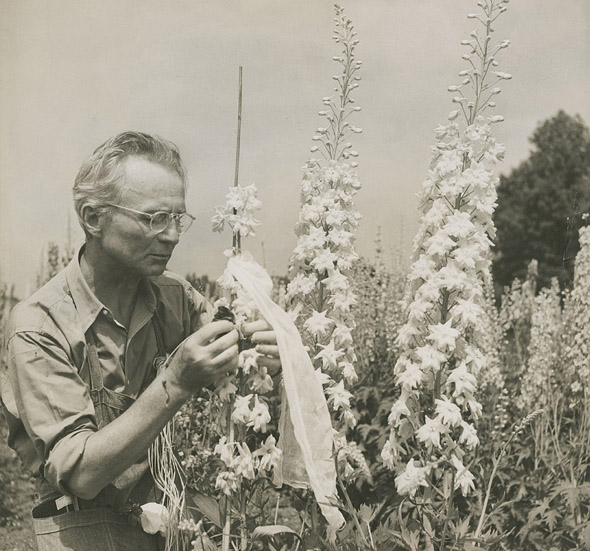 Edward Steichen with delphiniums (c. 1938), Umpawaug House (Redding, Connecticut). Photo by Dana Steichen. Gelatin silver print. Edward Steichen Archive, VII. The Museum of Modern Art Archives
The League employed instructors, held art classes and exhibitions. After his apprenticeship, Steichen was promoted to the drafting room at $25 a week, which was soon increased to $50. He signed posters for beer, patent medicines, farm products and so on but the poster whose influence was felt round the world was the one designed for Cascarets — a luscious lady reclining in the lower curve of a giant capital letter C. Nights, noons, holidays and Sundays Steichen worked with his camera and paint brushes. For three years he submitted paintings to the Chicago Art Institute, only to have then rejected by the jury, but in 1898 all the photographs he sent to the Philadelphia photographic Salon were accepted. The next year several photographs were accepted for an exhibition held by the Chicago Art Institute.
Then Steichen gave up his job, took his savings, his paintings and his photographs and set out for New York. One of the first things there to greet his eyes was a huge billboard showing his Lady of the Cascarets in giant proportions. He went to the New York Camera Club and there met Alfred Stieglitz, who was already familiar with his work. Stieglitz bought his photographs, encouraged and advised him. In 1901 an exhibition of Steichen photographs was held in London. Bernard Shaw was one of his most enthusiastic critics and became his friend.
Steichen, now dividing his time between camera and brush,went abroad. He met Rodin and confessed his ambition to make a great photograph of him. Rodin gave him the freedom of his studio and twice a week for six months Steichen cycled out there. One day he took his camera with him and after ten minutes posing carried away a superb photograph of the sculptor. For a year he traveled over Europe, photographing and making friends of the great ones of the day. In 1902 he had two paintings in the Paris Salon. He returned to New York that same year, when he was only 23, and was associated with Stieglitz in founding 291 — the little room at that number on Fifth Avenue which for years was the chief stimulus in this country for the modern trend in the arts.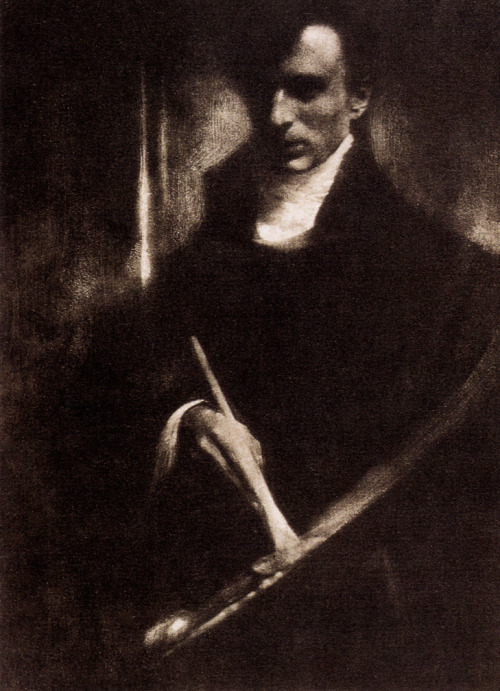 Photograph: Self Portrait of Steichen in 1903
Internationally known, Steichen photographed and painted with increasing success until the World War. He entered the air service in the first group of American air corps that was sent to France and during the second battle of the Marne was made chief of the photographic division. He came out of the war with the rank of Colonel, and with the red ribbon of the Legion of Honor.
The necessity for clarity and detail in aerial work had given him the new concept of photography. In 1920 he gave up painting to devote his time to photography. He is an Honorary Fellow of the Royal Photographic Society of Great Britain.
George Eastman House Delphinium Papers
Pages: 1 · 2
More Articles
- The Guggenheim Museum Exhibits and Store in New York City; Works & Process Commissions on Tour
- Lynn Hershman Leeson: Who Has Celebrated Her 80th Birthday and a New Exhibition, TWISTED, at The New Museum in New York City
- New York's Jewish Museum: Photography and the American Magazine; When Avant-garde Techniques in Photography and Design Reached the United States via European Emigrés
- The Scout Report: Civil Rights Toolkit; Be All Write; Plants Are Cool, Too; NextStrain; Women'n Art; 500 Years of Women In British Art
- Ferida Wolff's Backyard: Mushroom Hunt; Grasshoppers Leap Into the Future (on glass!)
- Ferida Wolff's Backyard: Hostas and Us; Waving Beans
- Spirits by Deborah Masters at the Museum of Arts and Sciences in Macon
- The Durrells in Corfu Return With Season Three Based on Gerald Durrell’s Trilogy with a Keeley Hawes Interview
- Chicago Institute of Art and John Singer Sargent, Georg Jensen and Arms, Armor, Medieval, and Renaissance
- Ferida Wolff's Backyard: Tulips in a Vase or On the Tulip Tree and Snake Alert


