


Capucci frequently finds inspiration in nature, sculpture and architecture. He considers his dresses to be 'habitats' and thus does not restrict his work to the shape of a woman’s body.
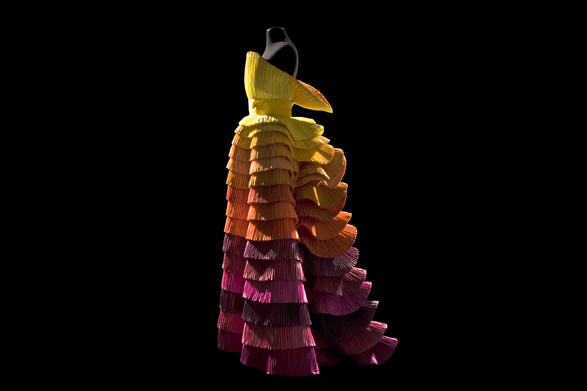
The exhibition traces Capucci’s artistic career chronologically, from his discovery in 1951 to his sculptures from 2007. Early works include a cocktail dress with train from 1952-1953, and the Rosebud dress from 1956, as well as the iconic Nine Dresses (1956), inspired by the rings of water produced by tossing a stone. His revolutionary box silhouette — shaped with four seams instead of the usual two — represented a bold departure from the traditional fitted form of the period and garnered him the prestigious Filene’s Fashion Award in 1958.
Capucci was born in Rome in 1930 and studied at the Accademia delle Belle Arti. He briefly worked as an apprentice to the designer Emilio Schuberth and opened his first atelier in Via Sistina in Rome in 1950, moving to Via Gregoriana in 1955, where he remains today. During this time, Capucci was introduced to Giovan Battista Giorgini, a buying agent for high-end American department stores who became his champion and organized the first Italian high-fashion show in Florence in 1951.
From 1962 to 1968, Capucci presented his collections in Paris to much acclaim and was praised for his inventive use of plastic, his Op Art-inspired designs made from woven ribbons (the 1965 Optical dress) that paid homage to the artist Victor Vasarely, and embroidered evening dresses that glowed in the dark. Upon his return to Rome in 1968, Capucci continued his experimentation with commonplace materials such as raffia, wire, and stones in the tradition of the Italian Arte Povera movement of the same period. In 1978, he created the white satin Colonna dress, modeled after a Doric column. The dress represented a key turning point in Capucci’s career, as he started to explore the idea of dress as actual sculpture. The exhibition contains dramatic sculpture dresses from the 1980s and early 1990s, such as the intricate Bougainvillea (1989) that reveal the striking use of pleating and exploration of color and form that are now his signature.
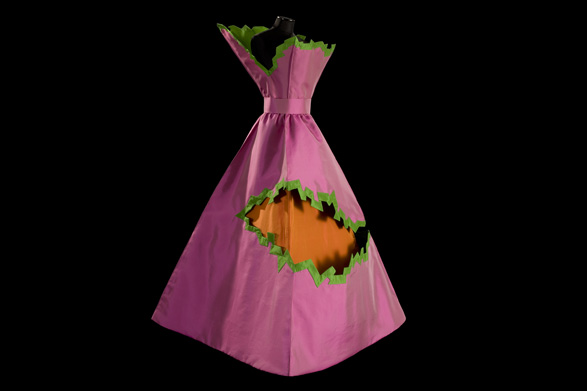
As he continued to explore new directions in the use of line, color, texture, and volume, Capucci refused to compromise his vision in the service of purely commercial concerns, and in 1980, he resigned from the Italian couture system. Instead, he presented a singular collection each year in a different city including Tokyo, New York, and Berlin. Among the works on view will be the series of eight dress sculptures, Return to Origins: Homage to Florence, from 2007.
The accompanying exhibition catalogue,  Roberto Capucci: Art into Fashion (Philadelphia Museum of Art) by Dilys E. Blum, organizing curator, consists of 220 pages with 22 black-and-white illustrations and 182 color illustrations.
Images courtesy of Philadelphia Museum of Art:
1. Previous page. Nove Gonne (Nine Skirts), 1956. Sala Bianca Palazzo Pitti Florence. Sculpture-dress, ‘bello’ red silk taffeta, overlapping elements on the skirt. Claudia Primangeli / L.e C. Service.
2. Sculpture Dress, 1992. Schauspielhaus Theatre Berlin. Sculpture-dress, multi-coloured plissé taffeta, overlapping pleats on the skirt. Claudia Primangeli / L.e C. Service
3.‘Crepe,’ 2007. Sculpture in the Box Line style. Fuchsia taffeta, green borders, orange taffeta inside. Fondazione Roberto Capucci.
Pages: 1 · 2
More Articles
- The Guggenheim Museum Exhibits and Store in New York City; Works & Process Commissions on Tour
- The Beige Book Summary of Commentary on Current Economic Conditions By Federal Reserve District Wednesday November 30, 2022
- A la Frank Sinatra: "Come Fly With Me", U.S. Department of Transportation Airline Customer Service Dashboard
- Ferida Wolff Writes: This Holiday Season
- Adrienne G. Cannon Writes: Those Lonely Days
- Annandale-on-Hudson, New York ... With Pleasure: Pattern and Decoration in American Art 1972 - 1985
- Lynn Hershman Leeson: Who Has Celebrated Her 80th Birthday and a New Exhibition, TWISTED, at The New Museum in New York City
- New York's Jewish Museum: Photography and the American Magazine; When Avant-garde Techniques in Photography and Design Reached the United States via European Emigrés
- Jane's Shortall's Amazing Return to London ... ‘Putting the Luxe in Luxury’
- From the CDC: When You've Been Fully Vaccinated You Can ........For the 30,000,000 Who Have Been Vaccinated


