But fall wouldn't be the same without bushel-sized potted mums and pumpkins at the front door. The garden mum's popularity (Chrysanthemum, zone 4-10) has grown as fast as the proliferation of its petal shapes and colors. Like other perennials, its use has also migrated across seasons and into use as an annual in the garden. Mums aren't hard to winter over--just store the potted plants in a cold frame or an attached garage. In my Northeast garden, mums were an inexpensive quick fix for an end of summer garden. It felt like cheating, but I loved slipping plants between clumps of fading perennials for a fall garden party.
Asters (zone 3-9) are also synonymous with fall and one of my personal favorites. Also called Michaelmas daisies (named after an English holiday during which they bloomed), these plants are perfectly timed to bloom for the autumn garden. They start to flower in mid-August in bright but gentle
 shades of pink, lavender, burgundy, mauve, and violet, and white. Some
are low and dwarf growing, others are giants. They need full sun and don't
like to be crowded.
shades of pink, lavender, burgundy, mauve, and violet, and white. Some
are low and dwarf growing, others are giants. They need full sun and don't
like to be crowded.
Like mums, many gardeners (including myself) treat asters like an annual. That's certainly how 'hardy' asters behaved in my New York garden. Very few came back the next year but that never stopped me from planting or trying. I prefer the New England varieties -- Purple Dome and Alma Potschke - over the New York varieties for better mildew resistance. I have yet to try asters in my subtropical garden but I've noticed that they are available at local garden centers for fall planting.
Another source of color in the fall garden is plants that can be coaxed into a second flowering with regular deadheading or shearing. I was successful with plants such as Autumn Snow candytuft (Iberis sempervirens), Centaurea montana (zone 3-8), Cranesbill geranium (zone 4-8), and spiderwort (Tradescantia, zone 5-10).
Toward the end of the season, foliage plants also contribute to the wonderful mix that makes a fall garden memorable. At summer's end, I was always grateful for plants such as silver Artemsia (Dusty Miller, Silver Mound, Silver Brocade, zone 4-10), Lavender (zones 5-9), catmint (Nepeta, zones 3-10), Lamb's ear (Stachys lanata, zone 4-8), coleus, red Shiso (Perilla frutescens), and sweet potato vine (Ipomea). They provided a backdrop of texture and color that shifted subtly with the changing of the seasons.
Cladiums are another important foliage plant in the deep South, my new backyard. For a year 'round display, the bulbs are planted in February and then again in August for color until frost or, in frost-free areas, whenever their clock says its time to rest.
Another annual plant that is very useful this time of year is ornamental cabbage and kale (Brassica oleracea). Like it's cousin in the vegetable patch, the ornamental variety thrive on cool temperatures and is edible, although the few leaves that make it to the kitchen are used as garnish. The ornamental forms have been bred to emphasize the colors of the leaves. But more than color, their unusual form is distinct and eye-catching in planters and at the front of beds. In the northeast I've seen such plants weather snow and ice and look attractive well into winter.
A few garden plants have a showy follow-up act to their initial blooming. Sometimes it was the showy red berries on Marie's viburnum (V. tomentosum Mariesi, zone 4-9) or the wine colored foliage and flower heads of the hydrangeas or the fuzzy seed heads above the ornamental grasses.
Other plants just wait till late summer to show off their stuff. You could call them patient or maybe they're just procrastinating. Who knows? In my fall garden, the stars included anemones, Autumn Joy sedum, goldenrod, Helen's flower, Stokes' aster, and black-eyed Susan. Shrubs that proved invaluable included butterfly bush, summersweet, and bluebeard.
After having almost disappeared from the cultivated garden, black-eyed
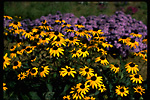 Susan (Rudbeckia Goldsturm, zone 3-9) made a big comeback a few years
ago. The familiar Rudbeckia flower, yellow petals and deep brown
"eyes," is borne in abundance for a long period of time as long as it gets
plenty of sun and warmth. Unlike its roadside cousin, R. hirta, the Goldsturm
cultivar is resistant to mildew and should be sturdy enough to stand without
flopping. Both are also impervious to drought and insects.
Susan (Rudbeckia Goldsturm, zone 3-9) made a big comeback a few years
ago. The familiar Rudbeckia flower, yellow petals and deep brown
"eyes," is borne in abundance for a long period of time as long as it gets
plenty of sun and warmth. Unlike its roadside cousin, R. hirta, the Goldsturm
cultivar is resistant to mildew and should be sturdy enough to stand without
flopping. Both are also impervious to drought and insects.
Stokes' asters (Stokesia, zone 5-10) are valued for its large, disk-like blue flowers produced continuously from summer until frost. The plant itself is short to medium and should need no staking if in full sun. At the southern end of its range, it's supposed to be evergreen (something I plan to test in my Florida garden) and bloom intermittently year round. Numerous cultivars have greatly expanded the color range from blue to white, yellow, pink, and lilac.
Japanese anemones (A. x hybrida, japonica, tomentosa, or vitifolia, zones 4-8) come into their own from mid-August through October, a marvel I first witnessed at Wave Hill Gardens in Riverdale, N.Y. A multitude of wiry stems rise above the foliage with buds that open to pink or white single or double flowers. They like light shade, rich humus soil, and moisture. My favorite is the nearly foolproof A. tomentosa Robustissima, a three-foot plant with single pink flowers that seems more adaptable to a wide variety of soils and moisture than other anemones. Unfortunately, the deer in New York also appreciate the plant's fine flowers and ate them as fast as the buds opened.

Helen's flower (Helenium autumnale, zone 3-9) should get some kind of award for longest-blooming perennial. It starts in late July and stretches to the end of September or frost. It likes full sun and soil that doesn't dry out. It can even tolerate wet feet. The daisy flowers are yellow but its cultivars introduced some delicious departures: chestnut with dark brown eyes, red and bronze, coppery red, brownish red, mahogany brown, and burnt orange.
Goldenrod (Solidago, zone 3-9) is still mistakenly blamed for hayfever (ragweed is actually the culprit). It comes in a wide range of yellows -- from muddy to lemon pie to deep gold. Some are aggressive but others, like S. sempervirens, S. altissima, and S. rugosa are better behaved. All
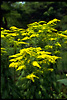 are
drought resistant and durable.
are
drought resistant and durable. Autumn Joy sedum (Sedum spectabile, zone 3-10) is one of the upright stonecrops that bloom freely from August to early frost. Stocky, succulent two-foot stems support a dome of tiny flowers, which are showy even before they open pink. The pink eventually turns to russet as it ages, which makes it difficult to combine with other flower colors. My solution was to combine it with the yellow of evening primrose (Oenothera youngi, zone 4-9) and a variety of ornamental grasses. The flower heads add winter interest if the deer don't find snack on them.
I was so taken with the butterfly bush (Buddleia davidii, zone 5-9) in my last garden that I had at least a dozen and an unlimited supply of seedlings. It doesn't get going until the weather is hot but then it's covered with flower spikes--purple, pink, or white--that are a magnet for butterflies and hummingbirds. In northern climes it needs to be cut back to 6 or 8 inches before growth starts in the spring. Where winters are mild, it starts blooming as early as mid-summer and will continue until a hard frost. Deadheading helps keep it in the flower-production mode.
Summersweet (Clethra ahnfolia, zone 3-9) is a medium-sized shrub that has white or pink spike flowers in late summer or fall. Its fragrance is unmistakable. It's quite a bee and deer attractor. Sometimes gardeners mistakenly cut it back in the spring thinking it's dead when in fact it's just very slow to leaf out.
Bluebeard (Caryopteris, zone 5-8) is one of my recent discoveries and I'm delighted to add this color to my garden's late-summer-and-into-fall color palette. It's actually a small shrub that grows to about 3 feet. At the cooler end of its range, it's treated like buddleia in the spring: prune by two-thirds or to 12 inches.