November 2001 Garden Edition:
Behind the scenes of "Making More Plants" by Ken Druse
by Linda
Coyner
Why are some books
successful and others not? At the November 2001 Garden Writers'
Symposium, Ken Druse's book "Making More Plants (Clarkson
Potter Publisher/Crown, $45) took home the Award of the Year,the
Symposium's highest honor. The American Horticultural Society
named it 'Best Book of the Year.' In sales, it's a blockbuster
in the pricey garden book category. The first press run—over
17,000— has already sold out and the book is back on press.
It's probably been the most reviewed garden book of all time.
An Internet search turned up more than 50 hits. So what's so special
about it?
The author
talked openly to fellow gardener writers about what went into
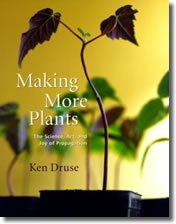 "Making
More Plants." He knew the topic of propagation had a marketing
potential that hadn't been tapped. Authors have taken on this
subject many times before but usually ended up with something
dry and technical. He felt that nothing seemed to capture the
exhilaration or wonder a gardener feels from creating a new plant.
So he knew he'd have to do something special to impart that feeling
and bring the subject to life.
"Making
More Plants." He knew the topic of propagation had a marketing
potential that hadn't been tapped. Authors have taken on this
subject many times before but usually ended up with something
dry and technical. He felt that nothing seemed to capture the
exhilaration or wonder a gardener feels from creating a new plant.
So he knew he'd have to do something special to impart that feeling
and bring the subject to life.
He also made the decision
to go first class on the materials for this book project: paper,
photographs, design. That translated into a $45-coffee-table book
that would have to overcome price resistance—after all, we
are talking about buyers interested in making plants for free.
The question of practicality is another issue. Would a fancy book
be a useful guide to the dirty, messy business of propagating
plants? One reader's suggestion solves the problem and is the
ultimate recommendation—buy two, one for the coffee table
and one for the garden.
The book doesn't take
the easy way out and shy away from the technical. Druse jumps
into the botany of the subject with both feet, gently taking the
reader with him. His chapters cover the wide range of ways to
create plants‹sowing, vegetative reproduction, cuttings, leaves,
layering, grafting, division, geophytes (all manner of bulbs),
roots, and even high-tech tissue culture.
So how did he pull
it off? It certainly helps to be an engaging writer and gifted
photographer who's genuinely enthused about his subject. Still,
that's no guarantee. But Druse combined those talents with the
determination to push the edge of the envelope by thoroughly researching
the topic. That way he could present information in the book first
hand and authoritatively.
Doing his homework
also served to make it easier to explain to the reader how to
do the task at hand. For the author, though, doing his homework
meant turning his home and garden in northwestern New Jersey into
a laboratory for three years. During that time he painstakingly
experimented with thousands of plants to find the easiest method
to propagate them. He compared accepted, recommended methods with
alternative techniques. If one method worked, he didn't stop there.
He tried and adapted methods until he was sure he'd found the
easiest method. Besides varying the method, he varied the parts
of the plants used, the time of day the cutting was taken, the
pre-treatment for the seed, the time of year, or whatever.
In addition, the author
was also determined to include a comprehensive appendix that charts
the methods of propagation, despite the work involved. The final
list covers more than 700 genera and thousands of species.
For this project, he knew beautifully arranged, colorful photographs
would play a big part in bringing the information, dense and dry
by its nature, to living and breathing life. He also knew he'd
have to take the shots at the same time he was doing the research,
no small feat. That would make it possible to explain the sometimes
complicated steps involved and how the plants looked a various
stages of growth. With infinite patience, he photographed seeds
and cuttings—roots, leaves, stems, bulbs—before rooting,
after rooting, as one-year-old plants and two-year-old plants
so that he could clearly show the progression.
He also used his own
hands in most of the photographs, something readers might not
realize. That's not the result of computer manipulation, but rather
the author's jerry-rigging of a non-mechanical cable shutter-release
that could be placed under his tongue and released without any
visible movement. For the book cover, Druse confides he fought
tooth and nail for the photo of a maple seedling, which was replicated
from an illustration in the book. The title of the book was another
matter. The publisher wanted "Natural Garden Nursery" to play
off the author's previous "Natural Garden" books. He stuck by
his title suggestion, "Making More Plants: The Science, Art, and
Joy of Propagation."
When the author was
asked why the type size was so small—my only quibble—he
said "too many words." The type size of photo captions is even
smaller, which is unfortunate since a lot of useful information
is contained in captions.
For more information
about the author, see www.kendruse.com.
More about Gardening