Coincidence, maybe, that red is also the color for the big holiday that took place last month: Valentine's Day. Red roses, red carnations, red whatever — if it doesn't come red, it's at risk of being dyed red. But what about black? According to The New York Times, black roses are now de rigeur in Manhattan. Of course, they're not a true black — more a dark red and maroon. Black Beauty and Black Magic were the two cut-flower varieties wholesale florists were bringing in from Ecuador and Holland. Supposedly, florists were getting $125 to $200 a dozen. If you're taken with the concept, I came across "Nearly Black" in Henry Field's 2000 catalog (Henryfields.com). The catalog copy reads "so deep red, it's almost black."
In hot climes, dark plants absorb so much heat that they're not likely to last long or perhaps burn up before the leaf or bud unfurls. Dark colors, used sparingly, add wonderful accents to the garden. In my local Florida Home Depot, I discovered Blackie, a striking form of the sweet potato vine (Ipomea), next to its chartreuse cousin. White Flower Farms describes its deeply divided leaves perfectly as 'ebony above and purple underneath.' (whiteflowerfarm.com). Neither of the Ipomea examples tolerate drought and need attention paid to watering, but it's well worth the effort.
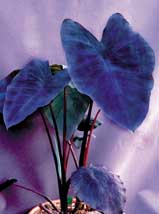
Another plant I'm tempted by is Black Magic Colocasia, also called Taro or elephant ears. It's available at TerraNovaNurservies.com. For several years I
 planted the football-size bulb of the green elephant ears in my
New York garden for a wonderful tropical effect. It's a tender bulb
there and needs to be brought inside for the winter.
planted the football-size bulb of the green elephant ears in my
New York garden for a wonderful tropical effect. It's a tender bulb
there and needs to be brought inside for the winter. My favorite dark foliage plant is red Shiso (Perilla frutescens), which I came across growing in a gravel parking area. I helped myself to a volunteer and haven't been without it since as I brought seeds with me to my new home in Florida. I didn't have a name for the plant until I found it at the Wave Hill garden in the Bronx borough. The color, which starts out intensely purple, darkens to a dull black by season's end. I was so taken with it for awhile that I let it run amuck in my gravel driveway. Then in spring, I'd systematically
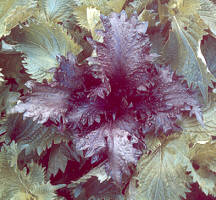
remove what I didn't want until I was happy with the shape of the border it had created on both sides of the drive.
Besides the color, it makes my favorites list because it's easy to grow, almost to the point that it could become an invasive plant unless you collect the not-so-showy flower stalks before they turn to seed. And, even better, the deer don't eat it. That's mostly due to its distinct aroma and flavor--cinnamon-clove with the spiciness of cumin, as described by Johnny's Seeds catalog copy (www.JohnnySeeds.com). The Catalog also makes note of the dishes that shiso is a culinary herb ingredient used in Asian meals and sushi.
If you want to experiment with the dark side, here are some other notable plants:
- German black iris 'Superstition.' Described as deep purple. Available from HenryFields.com, Van Bourgondien and DutchBulbs.com.
- Alcea rosea 'Nigra'. A single flower hollyhock described as chocolate maroon. Available from Gurney's, White Flower Farm; JohnnySeeds.com
- Black pussy willow (Salix gracilostyla Melanostachys'). Described as large, richly black catkins with yellow stamens and red anthers. Available from ParkSeed.com