by Linda Coyner
A subtropical garden may seem very topsy-turvy if you're accustomed to gardening anywhere else. Alice's Wonderland couldn't have been any wackier.In this land of riddles, for instance, we have annuals like impatiens grow into shrubs and live year after year while perennials die off in a season. Warm season, long-day plants like petunias and tomatoes go into the ground in winter. Farmstands close in the summer; in winter they lure visitors with "you-pick" strawberries and tomatoes. Plant labels that read "full sun" really mean partial shade.
I think, though, that I'm beginning to make sense of it. With one Florida summer under my belt, I know now that summer is far too hot and humid to be outside, and most of nature seems to agree. With few exceptions, plants retreat into what's called "heat stall," a dormancy of sorts, that preserves their life force. In spite of the long days of summer, growth slows, most fruiting stops, and flowers become scarce. Weeds, alas, are the big exception to the rule. In the heat, they thrive, growing like wild fire until perspiring gardeners pluck them out.
Summer has its beauty, don't get me wrong. Problem is, it's mostly viewed through a window in an air-conditioned room. Fantasize about a garden up north growing vigorously year round. Now imagine what it would be like to take care of it--weeding, watering, digging, raking--at its coldest. The only difference is that instead of cold, it's hot.
The result? Nature makes the best of the rest of the year, especially winter, which becomes prime gardening time and growing time, as well as a desperately needed respite from the heat. Even though the days are short and water is in short supply, conditions are more conducive to plant growth, albeit slow by most standards, and flowering.
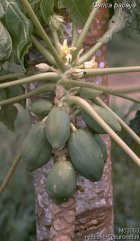
At this very moment a wonder inhabits my backyard, a papaya tree. It is heavy
with at least a dozen football size fruit that's ripening yellow
and orange. As an eight-inch seedling won in a plant raffle, I
planted it out in late May (seven months ago) and it now reaches
12 feet, which is actually short for a papaya.
Other plants I consider winter wonders are bougainvillea and poinsettia. The bougie, as it's known, is a sprawling, spiny shrub that would be unremarkable if it weren't for its wildly colored flower bracts that light up the landscape. It'll bloom sporadically all year as long as it's kept on the dry side, which is hard to manage when it's anywhere near a lawn sprinkler. So when the short, dry days of winter begin so does profuse flowering. The poinsettia, a popular holiday plant, is at home in this subtropical clime and needs no special conditions to thrive. It grows into a large landscape shrub and colors up its flower bracts without any coaxing in the short days of winter.
Some of the riddle can be explained away. Petunias, for instance, which require long days and summer heat to bloom, are planted in the short, cool days of winter in Florida. Growers have learned to simulate long days with artificial lighting, and apparently Florida's winter sun is warm enough to keep them happy. Summer, I've learned firsthand, is too hot and humid for them. I 'm told Christmas cactus, a popular holiday plant, needs a dunking in ice water to set buds when no frost is to be had, roughly the equivalent of being outside for a couple frosty nights up north.
Another riddle of sorts is the current fascination with deer ornaments as part of the holiday lights. This year, in addition to icicles, light grids, and tree wraps, life-size deer appeared. These decorations move their heads from side to side to mimic grazing. Many gardeners, myself included, consider the sight of a deer in the garden a horrifying specter.
The fact is that gardeners in Florida don't worry much about deer. The indigenous variety, the dog size Key Deer, is concentrated in the southernmost part of the state. Even there it doesn't present a problem because of steadily declining numbers that have earned it endangered status.
In colder climes co-existing with deer is no joking matter and one that I have wrestled with. Deer trails traversed my New York gardens, evidenced by tracks and droppings and the inevitable damage. I don't mind sharing my garden with wildlife--up to a point, but when evergreens turned into skeletons overnight and prized flowers buds disappeared, it was more than I could stand.
While research and a lot of hope are pinned on a birth-control pill for deer, gardeners must consider the alternatives. The most successful remedy is a sturdy eight-foot. high woven wire fence. Other reports indicate that two additional fence options are effective: a solar powered electric fence 40 inches high and an electric fence 4 feet high and 5 feet wide, angled at 45 degrees.
In my experience, a makeshift lattice fence will reroute them away from your garden for awhile until their numbers and need for food force the herd back. At various times, I tried human hair as a mulch and in sachets; hanging bars of perfumed soap; and countless bags of Milorganite, a composted municipal-waste fertilizer. I'm not so sure they did anything about the deer but at least the Milorganite was also a fertilizer and the hair eventually increased the soil's organic matter. (Perfumed bars are no longer recommended as ingestion can make wildlife sick.)
According to www.mydeergarden.com, one of the most effective and natural deer deterrents is predator urine. I carefully avoided use of predator urine in my garden because of reports that it is inhumanely harvested from coyotes. More useful than specific product recommendations, that web site offers a searchable database of deer-resistant plants and a free monthly newsletter full of good information. There's a new systemic product in the form of a tablet that, when placed in the ground near a plant, absorbs the chemical into the stems and leaves affecting the taste of the plant. Apparently the product doesn't make the plant unpalatable enough to deter deer.
I never tried any of the do-it-yourself recipes for sprays but did have some success with repellent sprays. The latest studies show them more effective if rotated. A lot has to do with the size of the herd of deer you're trying not to feed, its appetite, and what you've planted. No plants except very spiny ones were spared in a winter with snow cover and a big herd. But spiny leaves are no guarantee of safety because new growth on such plants lacks hardened spines.
In my northeast garden, I was fortunate to get away with a once-a-season-spray like Tree Guard. It proved effective in trails by Consumer Reports Magazine a few years ago. It won't prevent damage, but it did save just about everything in my garden as long as I sprayed every three months or so, especially on new growth. I also like that the product is free of animal urine and slaughterhouse wastes. Note that Tree Guard is not recommended for edible plants. Available from www.tomsgarden.com, Deer-Off is another once-a-season spray that proved effective in those same tests. Gardens Alive, a catalog for environmentally responsible products, says Deer-Off is safe and all-natural. You can also safely use it on edibles -- in the vegetable garden and on fruit trees -- something other sprays can't say. Deer-Off is available from Gardens Alive (www.gardens-alive.com).
If the deer pressure is heavy, you may have to resort to weekly sprays like Hinder or Bobbex. Besides being inconvenient, weekly spraying may be logistically difficult since some can only be applied when temperatures are above 40 degrees Fahrenheit and conditions are dry. Check product labels for manufacturers' instructions. Available from www.tomsgarden.com
Gardeners also worry about cold protection, even in the subtropics. In the quest for variety, gardeners are constantly testing the hardiness limits of plants. Tonight, for instance, forecasters are predicting frost in Southeast Florida. It was luck that I planted the tender papayas on the warm, south side of the house. That's makes a difference even in a frost. Up north that would have been a problem. Tender plants should be located with a northern or eastern exposure to avoid big temperature fluctuations.
A bigger problem is that the impatiens and angle-wing begonias in my garden are scattered all over. For those I'll use the same strategy I would up north for a frost warning: cover tender plants as best I can with towels, blankets, and sheets (no plastic). In the morning, before temperatures rise, I'll uncover them.
For northern gardens, here are some general guidelines: