Garden Edition, June
2003:
Exploring the Mysteries
of Garden Design
by Linda Coyner
Gardening is about more than hard labor and getting plants to thrive. Somewhere between backbreaking digging, shoveling, and dragging home plants, mulch, and fertilizer is a mysterious creative process that comes into play. It quietly tells us what plant goes where, the shape of the bed, the curve of the path, and the position of the bench. For the lucky few it comes naturally, even intuitively. The rest of us scratch our heads and ponder designs and photographs of public and private gardens that work and pour through books trying to explain design.That creative process is, well, complicated. It juggles such concepts as color,
texture, form, order, unity, and rhythm. Most professionals designers have to go school to understand design principles. Two very different books that try to translate those principles and the how-to of the creative design process are The Well-Designed Mixed Garden by Tracy Disabato-Aust and Designing with Plants by Piet Oudolf (both Timber Press).
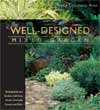
The Well-Designed Mixed Garden follows on the heels of the author’s best-selling The Well-Tended Perennial Garden. Her first book was a reference book on the how-to of maintenance for perennials. In this ambitious effort she tackles design and maintenance issues of the mixed border.
The book’s hefty size is intimidating but don’t let that put you off. More than half of the 460-plus page book is comprised of spreadsheets, charts, and lists — basically reference material. The spreadsheets list plants alphabetically showing characteristics such as form, height, width, flower color, flowering month, foliage color, foliage interest, texture and design color. A separate culture chart lists plants alphabetically explaining their soil, moisture, light, and soil ph needs. You’ll also find a section of lists — plants for specific colors schemes, textures, flowers, foliage, fruit, and color.
The balance of the book is devoted to a discussion of design elements. The author covers color, texture, form, scale, proportion, and line in this section. The text is rich with information and the author’s insights. The level of detail rivals that of a textbook, best suited to gardeners with a serious interest in design or setting out to become professionals.
But the heart of the book is Disabat-Aust’s discussion of color. She tackles color interactions, texture and form, light, intensity, value, and hue. Light, she explains, starts with a blue cast at daylight, then warms to reddish or pinkish, then orange, then yellow and a white with a tingle of yellow, and finally blue or violet. The author gives advice on balancing saturated colors (with the use of neutrals) and taking advantage of the fact that smooth surfaces reflect more light than matte or rough-surfaced ones (texture and form). For good proportion and color balance (intensity), she suggests combining a larger group of lower-toned colors with a small amount of more intense color. To balance full-intensity colors, use more darker colors than light colors. Intense colors in the garden can be balanced with the use of more darker than light colors (value).
Disabat-Aust doesn’t overlook the emotional aspect of each color. She goes through the color spectrum, explaining the feelings that each color elicits and associations made with it.
The writing style is at its best when the author adopts a personal tone: “I’m not sure why I didn’t want orange around — probably some preconceived notion that it was bad in some way and it might mistakenly get next to a pink and we would have to call 911.”
Two other sections are used to demonstrate design elements in action: designs for small, medium, and large gardens and the encyclopedia of plant combinations. The generous use of gorgeous photos and diagrams provides much needed relief to the dense information. Also welcome are the detailed photo captions that identify plants and the use of their Latin names.
A book with a totally different approach is the beautifully illustrated and designed Designing with Plants by Piet Oudolf. The Dutch designer and nurseryman explains his philosophy of design through Noel Kingsbury, a British landscape designer. According to Oudolf, gardens that are the most successful are those that balance art and control with nature and wildness. His goal is to bring nature and gardens closer together. One observer noted that his plants look wild but his gardens do not.
To accomplish this, Oudolf concentrates on perennials, introducing the reader to obscure garden plants such as astrantias, grasses, and umbellifers (members of the Apiaceae — cow parsley family) with strong structures. The unavailability of those plants led him to start his own nursery, where he breeds new varieties for specific design purposes. The nursery focuses on breeding asters, astrantias, monardas, and sanguisorbas.
In Oudolf’s naturalistic designs, color takes a back seat to structure and form. “If the forms and shapes of plants in a border work well together, and you choose plants that still resemble their wild ancestors, it is difficult to imagine an inharmonious color combination arising.” The reason, the book explains, is the natural proportion between the flowers and the foliage of wild plants; the extra foliage provides a green buffer that’s missing in garden plants with oversized flowers. “
A good planting,” Oudolf says, “should have enough variety of shape to look interesting in a black-and-white photograph — looking at it again in color should add another dimension, but a secondary one. Color has much more to do with the overall mood of the planting. Finally there is the dimension of time to consider, as perennials and grasses have such a dynamic way of growing, changing form dramatically as the year proceeds.”
Oudolf recommends that gardeners study their raw material: the plants. The book guides the reader through a close examination of plants, first by grouping plants according to general flower forms that relate to aesthetics or how they work in the garden: spines, buttons and globes, plumes, umbels, daises, screens and curtains, and leaves and shape. Leaf shape and texture are examined next. Only then is color and the moods evoked broached in wonderfully descriptive categories: hot, cool, sweet, somber, and earthy.
In “Designing schemes” Oudolf shows readers how to apply his design principles. From a selection of plants that are close to their wild ancestors, he builds structure and form using shapes and textures and adds filler plants to bridge any gaps and add transitions. Grasses are among his favorite plants, a subject to which he devoted his last book, Gardening with Grasses (Timber Press).
Odulf’s landscape designs are famous for creating feeling and atmosphere and the book’s photographs beautifully capture mood in the garden. He explains that “mood is something that can only be planned into a garden to a limited extent.” Even so, he says, if you accept certain conditions, you can work with the surroundings and variables like weather and light to create garden moods that make the most of their circumstances. Techniques that help include using grasses to catch the light, plants that provide movement, and tall perennials for drama and mysticism.
Resources www.timberpress.com