Garden Edition:
June 2001
What in the world is happening to petunias?
by Linda Coyner
What in the world is happening to petunias? Supertunia? Tidal Wave? Surfinia? It wasn't that long ago that there was one kind of grandiflora. Summers flowerbeds were filled with large, deep throated, velvety blooms with bold color. At night they wafted a light, sweet fragrance. When I sharpen my focus, I also recall certain imperfections: constant deadheading and, after a rain, that unsightly wilted look.
Our old-fashioned favorite is the subject of intense research in the laboratory and the field. The tinkering actually began a long time ago. The first petunia came from South American more than two centuries ago, where more than 30 species were found. Two of those species‹white Petunia axilliaris (previously known as P. nyctagiflora) and the magenta Petunia integrifolia (P. violacea) were crossed to produce the garden petunias we know as P. x hydrida.
Petunias belong to the Solanaceae or nightshade family, keeping company with tomatoes, peppers, potato (including Ipomea, the chartreuse sweet potato vine now in vogue), and Salpiglossis, which the early petunias closely resembled.
As early as the beginning of the nineteenth century, European breeders saw petunia's potential and were experimenting to develop larger flowers and more colors. In the 1950s the first red petunia came on the market. The first yellow petunia followed in the 70s.
For the last couple decades, breeders, including Suntory Ball Seed, Pan American Seed, and the Floral and Nursery Plants Unit of the U. S. National Arboretum, have worked feverishly to add a wide range of colors, new flowers, and forms, as well as weather tolerance.
One such effort is Dr. Rob Griesbach's, who is with the U.S. National Arboretum's Research Unit. He went to work crossing P. integrifolia with P. exserta, which is a woody shrub with bold red flowers. However, P. exserta's flowers are small and star shaped. It's also very hairy but the worst of it is that the hairs smell bad, are sticky, and collect dirt. After continuous backcrossing to P. exserta, and selecting for its hairless aspect and larger flowers, Dr. Griesbach now has a 'line' of petunias that have large red flowers and no hairs. I can't wait to see a red flowering petunia shrub in the nursery.
In all this experimentation, about the only things that haven't changed are the plants' need for plenty of sun and fertilizer. Obviously there's a lot of trial and error in this experimentation. (I worry that some mutant will escape the lab and we'll have a petunia kudzu taking over the Everglades.) The success stories are obvious. Look at the garden centers where you'll see a bounty of colors, flowers, forms, and plants that even offer weather resistance. My first encounter with the new generation of petunia was the Wave. But it wasn't until I came across a Supertunia (which at the time I thought was a joke), that I realized petunias were being reinvented before my eyes.
Where do all these new cultivars fit in? Not to worry, we still have grandifloras and multifloras. The line between the two, however, is becoming hazy as new hybrids offer characteristics of both: weather resistance and numerous blooms. One approach is to put the intermediate-sized cultivars in a new category called floribunda. What follows is my attempt to make sense of it all, sidestepping an intermediate group and leaving new cultivars in the category they most resemble. The small cultivar, Fantasy, necessitated the creation of the milliflora category, as do the new vigorous trailers like Wave and Surfinia.
Grandifloras are what most think of as petunias; large-flowered petunias consisting of both single and double flowering forms. Single grandifloras produce generous-sized blooms up to five inches across. Some single varieties have ruffled or fringed petals. Others possess a trailing habit which make them ideal for window boxes and hanging baskets. The large flowers don't usually hold up well during rainy weather (but that's changing for some cultivars, see below) and often become unkempt and straggly by late summer. Most do best in cool weather. Varieties include Supercascade, Supermagic, Ultra Star, Falcon, Daddy, Picotee, Pirouette, Prism, Razzle Dazzle. Note that Ultra Star, Supercascade, and Storm are said to represent a significant step forward in weather resistance.Multiflora petunias have smaller flowers (one to three inches across) in greater numbers. There are both single and double flowered versions. The plants and flowers are generally compact and performance in hot or wet weather is better overall than for grandifloras. Of late, resistance to wet weather has been improved, according to one report, by selection of plants with a waxy epidermis that sheds the rain from the petals. Varieties include Celebrity, Duos, Primetime (Primetime 'Summer Sun' has true-yellow flowers), Carpet, Delight, Madness.
Milliflora is a category created specially for Fantasy petunias, a cultivar introduced in 1996. Expect compact miniature plants two-thirds the size of a normal petunia. Actual height and width is six to eight inches with flowers that are an inch or so across. It takes several to fill a medium-sized pot and are best used in containers rather than flowerbeds.
Calibrachoa Million Bells also belongs in this group because of its diminutive size, although it is a trailer. It isn't a true petunia but looks like one and is treated like one. It's a small and compact plant with flowers that are less than one inch across. (See the May Garden Edition for more information.)
Vigorous trailer is the category that fits newer cultivars like Surfinia, Wave, Supertunia, and Tidal Wave Hedgiflora. To varying degrees, all have a cascading/prostrate habit.
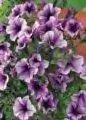
Surfinia petunias are the ones you see in Europe, cascading in sheets of color from window boxes. They are recognizable by a distinctive veining pattern in the blooms.
Wave excels as a carpeting groundcover in a good sized area. Plant on two-foot centers. Purple Wave is very low growing (four to six inches tall) with magenta flowers that are two inches across. Pink, Rose, and Misty Lilac Wave are more upright (six to eight inches tall) with slightly larger blooms. Supertunia is a vining (but not climbing) petunia that needs plenty of room to cascade. It's more aggressive than Surfinia. Flowers are three to four inches across.
Tidal Wave Hedgiflora is the 'hedge' type of petunia that, when planted closely, say one foot apart, can grow into a dense, mounded mass 16 to 22 inches tall. Grown in a restricted space with supports, it will grow an extra two to three feet upward, like a vine.
Happy planting!