Senior Women
Web Interviews Muriel Siebert
by Mary McHugh
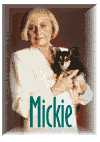
She is certainly one of the most powerful women in finance in this country as the first woman to own a seat on the New York Stock Exchange and the first to head one of its member firms, Muriel Siebert & Co., Inc., but she is also nicknamed Mickie, and is the most unpretentious and generous of women in any field.
When you walk into her impressive offices on Third Avenue in New York, you might find Monster Girl, Mickie’s little fluff of a Chihuahua yipping out a greeting to you. She has the run of the office poking her nose into everyone’s business in the course of her day with Muriel. “I can’t imagine life without her,” Mickie says. Indeed Monster Girl went with her when the Stock Exchange honored Ms. Siebert on her 30th anniversary by inviting her to ring the closing bell.
Buying that seat was no easy matter in 1967, as you might imagine. Do you remember women’s place in the world of Wall Street trading in those days? It almost didn’t exist, but Muriel Siebert was determined to forge ahead against formidable opposition. She was a partner in a leading Wall Street brokerage firm, but she had been turned down by nine of the first ten men she asked to sponsor her application for a seat on the Exchange. The Stock Exchange made up a new condition before they would accept her: she had to have a letter from a bank saying they would lend her $300,000 of the $450,000 price of the seat. But banks would not lend her the money until the Stock Exchange would agree to admit her. She managed to overcome all these obstacles. “For everyone who was terrible,” she said on an interview on the Charlie Rose show (you can watch the whole interview on video by going to www.siebertnet.com), “a stranger would offer to help.”
Did she get this determination from parents who told her she could do anything she wanted to do in life? Not at all. She grew up in Cleveland with a dentist father and a mother who had a “God-given voice,” but was denied the chance to use it by her family. “Nice Jewish girls didn’t go on the stage,” Mickie says. “I saw her frustration and decided I would do whatever I wanted to do. I’m a rebel.”
She dropped out of Western Reserve before receiving her degree because her father was dying of cancer and she went home to help. “I never looked back,” she says. “The only problem was I had to lie to get my first job and tell them I had a college degree. They didn’t check, but when I applied for my seat on the Stock Exchange I told them. I knew this application was bigger than just Mickie Siebert. It was a historic application and I didn’t want to lie.”
In 1977 Ms. Siebert, a Republican, was appointed Superintendent of New York State’s Banking Department by Democratic Governor Hugh Carey at a time when bank failures were common in the rest of the country. She forced banks to merge, persuaded stronger institutions to help weaker ones, and in one of my personal favorite moves, compelled one bank president to cut his salary in half by $100,000. “He had made bad mistakes in investments,” she says. “I felt his salary should reflect how well he had done for the owners, his depositors.” Because of her efforts, not one bank failed in New York State.
In 1982 she resigned from her position in government to run in the Republican primary for the United States Senate. She didn’t get it, but there was a slight look of regret on her face when I said I was sorry she didn’t get into the Senate. “That would have been a totally different life,” she said. “I still wonder about it.”
Muriel Siebert is a Founder and Board member of The WISH List (Women in the Senate and House), a political action group which supports pro-choice Republican women candidates for higher office. I asked her if there were many Republican women in Congress who are pro-choice, and she said most of them are.
She has used her name and support for many worthy causes, among them New York’s Minority and Women-Owned Business Enterprise Advisory Board, the Women’s Forum (of which she is currently president), and the New York Council of Boy Scouts of America. She has been given awards from every organization from the Financial Women’s Association “Woman of the Year” award to the International Women’s Forum Hall of Fame. She also had a vine named for her in the Veuve Clicquot vineyard and enjoyed a two-day ceremony with much tasting of champagne.
Her current projects include a new museum being built in Battery City Park for women, which will be a leadership center offering seminars on finance, as well as a women’s museum. She has also worked with the New York City Board of Education to develop a program to teach high school students about money.
“It’s totally unfair to turn kids out into the real world without knowledge about money,” she says. “There should be a course that everyone graduating from high school has to take. It would teach them the difference between a fixed rate mortgage and a variable rate mortgage, the difference between leasing a car and buying one, how to avoid the pitfalls of credit cards (almost a million and a half people declared bankruptcy in this country three years ago, mainly from overspending on credit cards), how to open a checking account instead of going to check cashers which charge them an outrageous amount of money. They need to know what 401k and IRA accounts are and why they should have them. Basic things. Not all the crap.”
In October, 2000, the Siebert Financial Corporation started Women’s Financial Network (www.wfn.com) which is the first women’s site with online trading, and includes buying and selling of stocks, bonds and mutual funds, as well as free checking, online bill-paying and the ability to aggregate financial accounts on one site. It is a discount trading site as is her own company.
She is particularly tuned in to the concerns of older women who may not be as savvy about money as younger women are. “They come from an era when money was not a ladylike subject,” she says. “Look at all the trust departments that said to them, ‘Don’t worry your little head, we’ll take care of this,’ meanwhile going through their capital without their realizing it. Money, if you don’t understand it, is a threatening thing.”
Mutual funds are a recommendation as a place to start if you don’t have extensive investment experience. “You’ve got to get the portfolios of the mutual funds described in The New York Times, the Wall Street Journal, Barrons, or a number of other publications. You should pick a no-load, no transaction fee fund and see what kind of stocks they own. If you have faith in the drug industry you can buy a sector fund that concentrates on those companies. Or, you can buy a diversified equity fund that has some utilities, drug stocks and electronics."
"Devote some quiet thinking time to what you feel most comfortable with. You can open some mutual funds with $250 or $500, and put in as little as $30 or $30 a month," Ms. Siebert says. "I tell women they should be prepared to write a check to themselves for their own future every month for the amount they would spend on their most expensive piece of clothing. You have to use discipline or you’ll spend that money. You’ll wake up one day and you’re 50 years old and you have nothing. If you go into a fund that has 50 or 100 stocks, you have a better chance over a long period. For short term investments, you can put your money in a money market fund that pays more than a bank -- about 5% -- with free check writing privileges.”
Ms. Siebert thinks women are getting better about taking risks than they used to. “They are getting more confidence as they have been investing more, and when you get more confidence, you’re willing to take a higher risk.”
She feels that her site is targeted to women investors in a way that other Internet services are not. “Though there are sites out there that purport to address the financial needs of women,” she says, “in my opinion, they offer trivia and fail to provide the real tools women need. Even worse, many of them talk down to women. At a time when women realize they must take control of their finances, our site is being established to help them to just that.”
Muriel Siebert inspires confidence in people, especially women, who sense that she has their best interests at heart. She has spent her whole life carving out a place for women in the financial world and all of us benefit from that pioneering work.
As I said goodbye to her, Monster Girl followed me to the door and wagged her whole body in a Chihuahua farewell.