Killer Chick
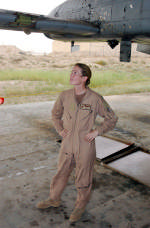
Capt. Kim Campbell is an honor graduate of the U S Air Force Academy, Class of 1997. She also holds a degree in International Security Studies from the University of Reading, England and a Masters in Business Administration from the University of London, England.
She’s a fighter pilot, with 120 combat hours in the A-10 Thunderbolt II , a fighter plane with the inelegant and unladylike nickname of Warthog. They call her the Killer Chick. (Her radio call sign is “KC,” which you may interpret as “Kim Campbell “ or “Killer Chick.”) And she is the most famous female fighter pilot since Lt. Col. Martha McSally (see Women in Blue and Women in Blue, Round II), who took on the Department of Defense in court a year or so back. And won. (Stationed in Saudi Arabia, Lt. Col. McSally challenged a regulation that required female service personnel to wear the abaya, the head-to-toe cloak worn by Muslim women, off-base.)
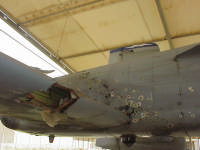
Capt. Campbell didn’t win her laurels in court, though. She won them in the skies over hostile territory, Baghdad, giving air support to ground troops, when her Warthog took a crippling ground fire hit.
She told Staff Sgt. Jason Haag, who is with the 332nd Air Expeditionary Public Affairs office in Iraq (she flew with the 332nd). “I lost all hydraulics instantaneously (an aircraft’s hydraulic system controls many of the plane’s key functions), so I immediately lost control of the jet. It rolled left and pointed toward the ground, which was an uncomfortable feeling over Baghdad. The entire caution panel lit up and the jet wasn’t responding to any of my control inputs.”
She changed her control methods to allow her to fly her plane without hydraulics.
"The jet started climbing away from the ground, which was a good feeling because there was no way I wanted to eject over Baghdad.”
The hits had come in the rear of the aircraft so the Killer Chick was unable to see the damage. Her flight leader, a lieutenant colonel, drew alongside to check out the damage.
"I could not have asked for a better flight lead,” she said. “He was very directive when he needed to be, because all I could concentrate on was flying the jet.”
Once clear of Baghdad, Killer Chick had two options. Either land the badly damaged craft or eject (“which I really didn’t have any interest in doing”).
"The jet was performing exceptionally well and I had no doubt I was going to land that airplane.”
And she did. After that, her big problem was keeping it on the runway and stopping it.
"When you lose all hydraulics, you don’t have speed brakes, you don’t have brakes and you don’t have steering. One of the really cool things that when I did touch down, I heard several comments on the radio — and I don’t know who it was — but I heard things like, — 'Awesome job, great landing,' things like that.”
That was April of last year. It didn’t take long for news of her flying feat to spread throughout the Air Force. An Air Force Times article this April, headlined, “Out of danger into the limelight,” reported her appearance at the Smithsonian’s National Air and Space Museum in Washington, DC — “aviation’s version of the Sistine Chapel” — where she was praised by Chief of Staff Gen. John Jumper before hundreds of Air Force Association delegates. In the months before, across the country, newspapers from her home town in San Jose, California, to her present home station, Pope Air Force Base in North Carolina (where she is a pilot in the 75th Fighter Squadron) have told her story. Not long ago Secretary James Roche told it to a group of defense writers.
The Fighter Chick told an Air Force Times reporter, ”It’s all been a little bit overwhelming. I’d gotten a few letters and e-mails, but when I got back here, saw all the attention, I realized it was a lot bigger news than I’d thought.”
Among her many letters and e-mails, is a note written on a napkin from ground troops thanking her and her fellow Warthog pilots for their support. The Killer Chick says, “When you get a note from somebody saying, ‘If you’d been a few minutes late, I wouldn’t be here now’ — that’s what it’s all about.”
© David Westheimer for SeniorWomen.com
Editor's Note: Read David's previous articles on Capt. Martha McSally: Women in Blue; Women in Blue: Round Two as well as a reference in Killer Chick.