


The "party gap" means not only that there continues to be a smaller percentage of women in the Republican Conference than in the Democratic Caucus (9 percent compared to 25 percent in the House), but that there will be few if any women in the Republican leadership. This has implications for the policies the leadership will prioritize.
Even though women voters don’t give preference to women candidates, the fact that the gender gap varies widely from race to race in every election means that candidate characteristics and appeals do matter. Republicans can cut into the Democratic advantage with women by the policies they propound and their willingness to address women’s issues.
But they probably won’t do this. The "extremes" in both parties are more likely to vote in party primaries and conventions where the candidates are chosen. By and large right-wing Republicans don’t support policies favored by most women.
Despite all the publicity on the emergence of conservative women as candidates, the final results saw a drop in the number of women in Congress. This is not a first. The number of women in Congress has dropped nine times since the first woman was elected in 1916. Progress always resumes, though not always in the next election. Women also lost ground in the state legislatures, and not for the first time. All the 2010 drop means is that women still have an easier time being elected as Democrats than as Republicans and the Republican sweep knocked out a lot of Democratic women.
The Speakership has also shifted between the parties frequently in the past — four times between 1947 and 1955. So don’t assume that Nancy Pelosi — the first woman Speaker and one of the most effective ever — is permanently out just because the Democrats are down.
Redistricting will make the 2012 election a whole new ball game. Ironically, new districts drawn by newly Republican legislatures will be harder for the Democrats to win, but should create new openings for women.
©2010 Jo Freeman for SeniorWomen.com
Editor's Note: Jo Freeman's most recent book is 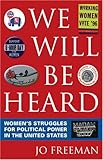
We Will Be Heard: Women's Struggles for Political Power in the United States by Jo Freeman
Pages: 1 · 2
More Articles
- Jo Freeman Writes: Kennedy vs. Trump at the Libertarian National Convention
- Women's Labor Force Exits During COVID-19: Differences by Motherhood, Race, and Ethnicity
- Selective Exposure and Partisan Echo Chambers in Television News Consumption: Innovative Use of Data Yields Unprecedented Insights
- Jo Freeman Reviews Thank You For Your Servitude: Donald Trump's Washington and the Price of Submission
- Journalist's Resource: Religious Exemptions and Required Vaccines; Examining the Research
- Jo Freeman Reviews: Lady Bird Johnson: Hiding in Plain Sight
- Jo Freeman Writes: Sex and the Democratic Party – In Brooklyn
- Jo Freeman Reviews MADAM SPEAKER, Nancy Pelosi and the Lessons Of Power: “An iron fist in a Gucci glove”
- Jo Freeman Reviews Mazie's Hirono's Heart of Fire: An Immigrant Daughter's Story
- Jo Freeman: The Georgia Peach Is Purple


