


“What you’re exploring here is the subtle ways in which the companies and professional societies become partners and — wittingly or unwittingly — physicians become agents on behalf of the interests of the sponsoring company,” said Dr. Steven Nissen, chair of cardiovascular medicine at the Cleveland Clinic.
“It has a not very subtle effect on medicine,” said Nissen, an expert on the impact of industry money.
‘This is our business’
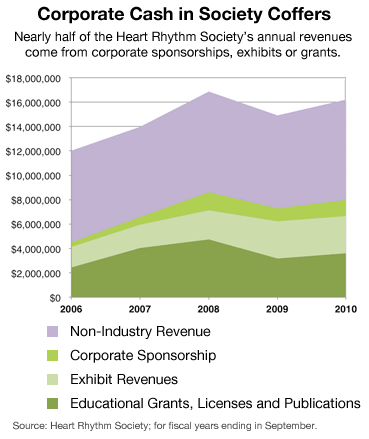
Nearly half the $16 million the heart society collected in 2010 came from makers of drugs, catheters and defibrillators used to control abnormal heart rhythms, the group’s website disclosed.
Officials of the Heart Rhythm Society say industry money does not buy influence and is essential to developing new treatments. Still, on Thursday the group unveiled a formal policy that, among other things, requires more detailed disclosure of board members’ industry ties.
“This is our business,” said Dr. Bruce Wilkoff, the incoming society president. “We either get out of the business or we manage these relationships. That’s what we've chosen to do.”
The society is one of a handful of groups that make public details about their finances. Most don’t. As non-profits, they must disclose their tax returns but not their specific sources of funding.
Sen. Charles Grassley, R-Iowa,requested the information from the Heart Rhythm Society and 32 other professional associations and groups that promote disease awareness and research.
Their responses and reporting by ProPublica showed wide disparities in money the groups accept from medical companies, what they disclose and how they manage potential conflicts of interest.
With billions of dollars at stake, companies can court entire specialties by helping to bankroll doctors’ groups. The Heart Rhythm Society’s 5,100 members represent a particularly lucrative market.
More Articles
- Medicare Advantage Increasingly Popular With Seniors — But Not Hospitals and Doctors
- National Institutes of Health: Common Misconceptions About Vitamins and Minerals
- A Yale Medicine Doctor Explains How Naloxone, a Medication That Reverses an Opioid Overdose, Works
- Kaiser Health News Research Roundup: Pan-Coronavirus Vaccine; Long Covid; Supplemental Vitamin D; Cell Movement
- How They Did It: Tampa Bay Times Reporters Expose High Airborne Lead Levels at Florida Recycling Factory
- A Scout Report Selection: Science-Based Medicine
- Journalist's Resource: Religious Exemptions and Required Vaccines; Examining the Research
- Government of Canada Renews Investment in Largest Canadian Study on Aging
- Kaiser Health News: Paying Billions for Controversial Alzheimer’s Drug? How About Funding This Instead?
- Medicare Covers FDA-approved COVID-19 Vaccines; You Pay Nothing For the COVID-19 Vaccine


