


The organization of the book is exemplary, with the material presented in eight “Acts”. “Act One” consists of several chapters on Athens itself. Ms. Hughes introduces us, not only to the history of the city, but also to the places, sounds, smells and textures of daily life, drawing us in to the life of ancient Athens as Socrates would have experienced it. Ms. Hughes’ knowledge and actual experience of the city’s places and monuments is extensive, and she is able to put us virtually in situ.
In “Act Two,” we see Socrates as a young man growing up in the Alopeke section of Athens, son of a stone mason. The city is, under the wing of Pericles, just setting out on its great experiment in democracy, the very first time this governmental concept had ever been thought of, let alone enacted. We now call it “The Golden Age Athens,” when everything seemed new and possible.
Having fought and finally won the battles of the Persian incursions, there was a period of peace, encompassing the building of many new monuments, temples, and public buildings.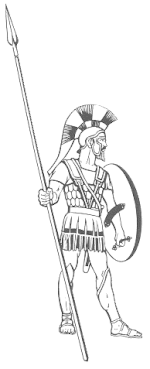
Illustration: "Classical Warfare: The Age of the Greek Hoplite " in Ancient and Medieval Warfare: The History of the Strategies, Tactics, and Leadership of Classical Warfare.
Socrates had already become known as a philosopher by the end of this peaceful time, but with the advent of the First Peloponnesian War, we find him in the army as a hoplite, a spear-carrying, shield-bearing foot soldier.
As the Spartans were carrying out brutal, destructive raids on the outlying parts of the city, Pericles commanded that all citizens must move inside the city walls. This action was swiftly followed by a plague (some believe typhus) which decimated the overcrowded population of Athens.
The war ended with a thirty-year Peace Treaty between Athens and Sparta.
By middle age, Socrates was well-known in Athens, hanging out in the Agora and asking odd questions of his listeners. He always went barefoot, even in winter, and dressed in well-worn and tattered clothes. His insistence that a man should be more concerned with the state of his soul, or of becoming a good person, as opposed to acquiring wealth and fame, marked him as something of an oddball. However, he had many friends in powerful, high places, despite his modest birth and upbringing.
By 432, war was again breaking out. Socrates served, again as a hoplite, during the siege of Potidea by Athens.
The Second Peloponnesian War eventually eased its way into the Third Peloponnesian War, which ended in 404 BC, at which point Athens finally surrendered to Sparta. For two years, they suffered under the “Rule of the Thirty,” consisting of thirty Spartan-appointees who were actually Athenians, but they were also arch conservatives, and followed Spartan ways. They began a systematic reign of terror, culling the city of democrats, “disappearing” their enemies, removing children from parents who were “suspect,” etc. Eventually, they approached Socrates with a mission to fetch one Leon from Salamis to be put to death, which order the philosopher politely declined as follows:
“The Thirty ... often ordered many others to do such things, since they wanted to implicate as many as possible in their causes. At that time I made it clear once again, not by talk but by action, that I didn’t care at all about death — if I’m not being too blunt to say it — but it mattered everything that I do nothing unjust or impious, which matters very much to me. For though it had plenty of power, that government didn’t frighten me into doing anything that’s wrong.”
Socrates was then marked for death. However, very soon after his refusal to cooperate with the Thirty, the democrats who had escaped to Phyle, a place a few miles northeast of Athens, united to take back their city. They swarmed back to Athens, and during their battle with the Thirty, killed the leaders. They then promptly elected a new board of ten, one from each of the city’s tribes, to rule the city. The oligarchs were exiled to Eleusis, and all the democratic exiles (who had been living there) were recalled.
In an ugly afterwards, a year later, with the Spartans withdrawn from Athens, the democrats stormed Eleusis and killed the remaining oligarchs. Socrates, as ever, stayed apart from the fray.
According to Ms. Hughes, Socrates thus became the scapegoat for Athens’ shame that it could neither defeat the Spartans, nor could it control the enemy within. His refusal to take sides proved his downfall. In the end, she posits, it was his “... air of optimism, [his] sense of proportion, [his] moral certainty, [his] infuriating otherworldliness” that condemned him.
More Articles
- National Archives Records Lay Foundation for Killers of the Flower Moon: The Osage Murders and the Birth of the FBI
- Nichola D. Gutgold - The Most Private Roosevelt Makes a Significant Public Contribution: Ethel Carow Roosevelt Derby
- Oppenheimer: July 28 UC Berkeley Panel Discussion Focuses On The Man Behind The Movie
- "Henry Ford Innovation Nation", a Favorite Television Show
- Julia Sneden Wrote: Going Forth On the Fourth After Strict Blackout Conditions and Requisitioned Gunpowder Had Been the Law
- Jo Freeman Reviews: Gendered Citizenship: The Original Conflict Over the Equal Rights Amendment, 1920 – 1963
- Jo Freeman Writes: It’s About Time
- Jo Freeman Reviews: Lady Bird Johnson: Hiding in Plain Sight
- Women in Congress: Biographical Profiles of Former Female Members of Congress
- Updated With Key Takaways: Watch on YouTube House Select Committee Hearings at House on January 6th: "So many citizens are downplaying on what happened that day"


