SeniorWomenWeb's
Design Reviews

Animal House Style;
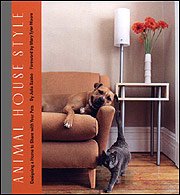
Designing a Home to Share with Your Pets
By Julia Szabo 2001
Bulfinch Press
We inherited a cat
with the house we moved into less than a year ago. Karl was too
old a feline to expect that he could adapt to a new home in far
off Hawaii. My husband spoils him with affection and he offers
us up gifts of garden pests he's stunned.
Although we had owned
two cats and two dogs at one time, sadly old age and disease overtook
them. No new pets had appeared in the interval as, with children
grown and living elsewhere, the house during our absence at work
would have been a lonely place.
We've read our share
of other decorating books which deal with every kind of style
imaginable excluding 'anarchist' or 'wasted.' I didn't quite know
what to expect from this book and encountered one full of helpful
and informative facts about what to do and what not to do to your
home while caring for pets. As Martha Armstrong, a vice-president
of the US Human Society
states in the introduction to the book,
Animal
House Style is really about another kind of interior: the
interior of the heart. The people and the animals in this book
share more than living space. Their relationships provide comfort
that goes beyond the touch of lush fabrics and the beauty of
fine furnishings. Theirs are deep, loving bonds that last for
life."
In this book you'll
find animal trainers cited who help dogs pass a co-op board interview.
There are wall surfaces and woods noted that call attention to
pet scratches. Designer Peter McGrattan's uses yellowed pages
taken from two copies of an edition of Gibbon's Decline and Fall
of the Roman Empire and laid down with several coats of polyurethane.
Not only will your animal's nails not be able to penetrate the
surface easily; he also may become a history buff!
Author Szabo reminds
us of the decorating and building materials that your pet will
find friendly. Cool-to- the-fur terrazzo and ceramic floors, low
maintenance surfaces like concrete, products to aid in both protecting
and enhancing your pets' lifestyle and environment. Fabrics, tips
for freshening the air, a variety of pet beds, sturdy but attractive
feeding bowls (think Fiestaware and Robinson Ramsbottom Pottery)
bathing techniques and wall treatments for animal friends with
claws and nails, filtering devices and even music to soothe your
beast's soul.
There are insights
into design firm allowances for pet owner sensibilities: one wallpaper
designer created several patterns in honor of his Cocker Spaniel
and a Ralph Lauren paint shade was named Golden Retriever. Artist
Hunt Slonem uses the colors of his parrots for the walls in his
apartment. Other artists, of course, have used their pets as subjects
and every February, Bonhams and Doyle co-host a Dogs and Cats
in Art auction of paintings in New York City, scheduled to coincide
with the Westminster Kennel Club Dog Show. Actually, there are
two well known decorators, Bunny Williams and Kitty Hawks (no
punning intended with their names) who have cofounded a animal-welfare
organization called Tails
in Need.
An innovative pet shelter
featured is Maddie's
Pet Adoption Center in San Francisco SPCA, where animals live
in furnished apartments rather than cages or crates: "Natural
light streams from windows and skylights and toys and TVs offer
entertainment and stimulation. Cats have private condos come equipped
with perches for sunning, trees for climbing and couches for snoozing.
They also have toys, TVs, aquariums and picture windows so they
can watch the birds outside."
Living
Color Enterprises is introduced in the book, a Ft. Lauderdale
firm that designs, engineers and fabricates custom aquarium systems
tailored mainly for a generous budget allowance, much more luxurious
that the examples you've seen in doctor or dentist's offices.
Imagine employing a reef architect, and using handcrafted corals
and abstract waves for the decor.
Animal House Style
notes a Tim Convery-designed sticker posted outside a house or
apartment that I've never seen. It conveys an alert in the spirit
of a 'In Case of emergency, Please Save Our Pets,' with space
to fill in the number and type of pet police officers and firefighters
will find in the home. The book contains information on the type
of environmental pet hazards that may inhabit your house as well
as how to gently rid your animal of irritants they may have picked
up both inside and outside of your home.
The book is lavishly
illustrated with photos of these creatures with and without their
owners, in appealing poses on chairs, beds, couches, laps and
whatever else can make them feel 'at home. Author Szabo has produced
a thoroughly entertaining and informative reading experience.
Armed with the book's generous resource guide with many Web addresses
included, I plan to pursue a number of the practical products
mentioned to pet and grandchild proof our home.